


 Jesse Jacoby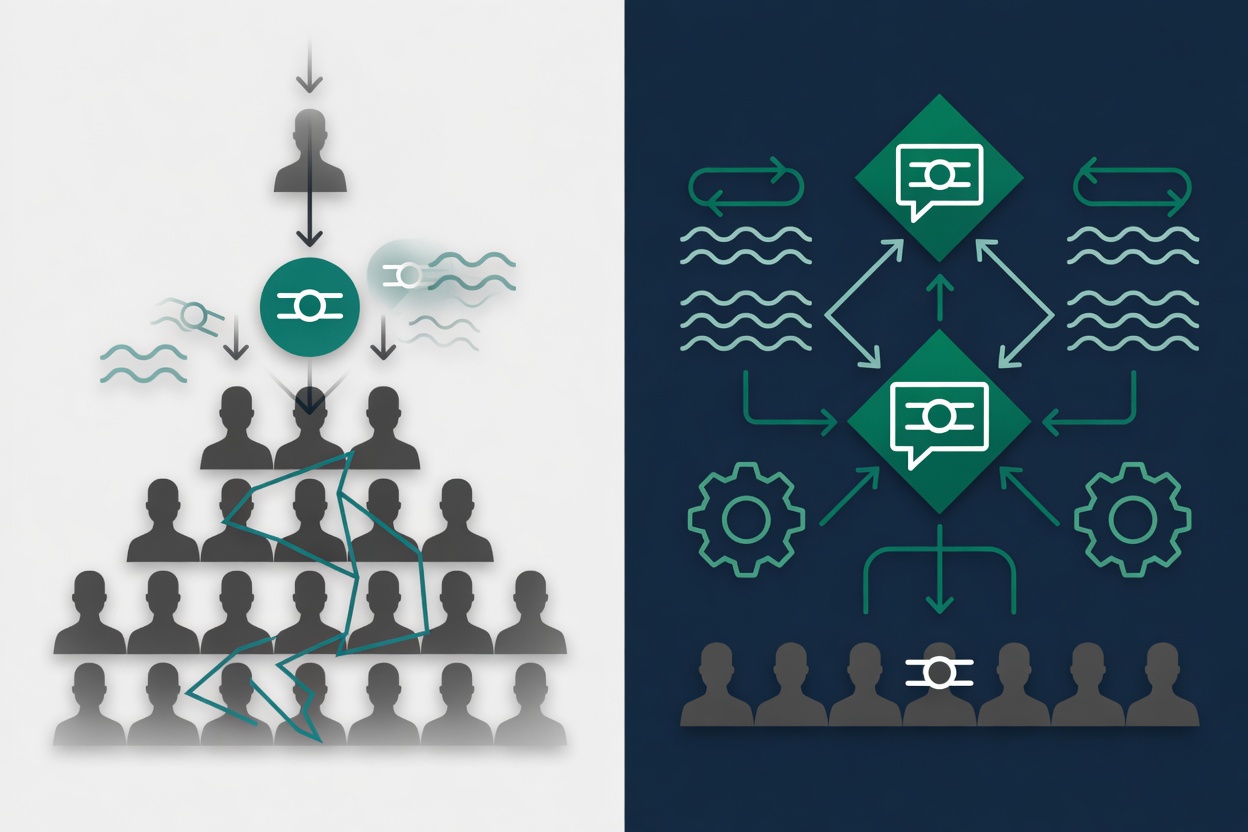
A chief transformation officer had what she called her “cascade problem.” Every major transformation update followed the same path: she briefed the executive committee, the executive committee briefed their direct reports, the direct reports held team meetings, and by the time the message reached the people actually doing the work, it bore almost no resemblance to what she’d originally said.
She wasn’t describing a failure of intent. Every leader in the chain genuinely tried to pass the message along. The problem was structural. Each layer of translation introduced drift. Context was lost. Nuance was stripped. And the informal commentary that surrounded each briefing (“here’s what I think this really means”) became more influential than the official message itself.
This is what happens when organizations treat transformation communication as content delivery. They focus on what to say and assume the how will take care of itself. It almost never does. The organizations that sustain alignment across long, complex transformations don’t just communicate well. They design a communication architecture: a deliberate system of channels, cadences, feedback loops, and narrative structures that holds the story together over months and years.
Town Halls Are Not a Strategy
The default communication playbook for most transformations looks something like this: a kickoff event, periodic town halls, a stream of email updates from the project team, a SharePoint site that nobody visits after week two, and a FAQ document that answers questions nobody is actually asking.
This isn’t communication architecture. It’s communication decoration. It creates the appearance of transparency without producing actual alignment.
Town halls are particularly seductive because they feel substantial. Senior leaders stand in front of the organization and talk. Questions are taken. Slides are shown. Everyone walks away feeling like communication happened. But research on organizational communication consistently shows that large-format, one-directional events are among the least effective vehicles for changing understanding or behavior. People remember roughly 10% of what they hear in a presentation 48 hours later. What they remember with far more accuracy is how the presenter made them feel and what their immediate manager said about it afterward.
The manager conversation is where communication actually lands. And in most transformation communication plans, it’s the most neglected element.
Designing the Layers
Effective transformation communication operates on at least four distinct layers, each serving a different purpose. Most organizations have one or two of these. The ones that sustain alignment have all four working in concert.
The narrative layer is the overarching story of the transformation. Why are we doing this? What does the future look like? What’s at stake if we don’t move? This isn’t a mission statement or a set of talking points. It’s a coherent narrative that connects the organization’s history to its future through the transformation. The best transformation narratives are simple enough to retell accurately and specific enough to feel real. They answer the question every employee is silently asking: “What does this mean for me and for the work I care about?”
The cadence layer is the rhythm of formal communication. Weekly updates. Monthly deep dives. Quarterly retrospectives. The specific cadence matters less than its consistency. When communication is predictable, people stop spending energy wondering when the next update will come. They know. That predictability creates psychological bandwidth for actually processing the content rather than managing the anxiety of not knowing.
The translation layer is where most architectures fail. This is the set of mechanisms that help middle managers and team leaders convert enterprise-level messages into team-level meaning. It includes pre-briefing managers before announcements so they have context. It includes providing not just talking points but discussion guides that help managers facilitate real conversations rather than read slides. It includes giving managers explicit permission to say “I don’t know” when they don’t, rather than forcing them to fabricate answers that erode their credibility.
The feedback layer is the upward channel that most organizations either lack entirely or have in name only. This is how the organization tells leadership what’s actually happening on the ground. Not through sanitized survey results or escalation processes, but through structured mechanisms that capture the real questions, the real concerns, and the real barriers people are encountering. When this layer works, leadership can adjust the narrative, the cadence, and the translation in response to what the organization actually needs to hear. When it doesn’t work, leadership keeps broadcasting into a void, increasingly disconnected from the reality they’re trying to change.
The Narrative Consistency Problem
One of the most underappreciated risks in long transformations is narrative drift. The story shifts subtly over time as different leaders emphasize different elements, as early promises meet operational reality, and as organizational priorities evolve. A year into a transformation, the version of the story being told in the supply chain organization may bear little resemblance to the version being told in commercial operations. Both versions might be internally coherent. But when people from different parts of the enterprise compare notes, the inconsistency creates doubt.
Narrative drift isn’t usually the result of deliberate misrepresentation. It’s the natural entropy of complex human communication systems. Without active maintenance, stories degrade the same way processes degrade: gradually, invisibly, until someone notices the output doesn’t match the intent.
The antidote is what I call narrative stewardship: assigning someone, or a small team, explicit responsibility for monitoring and maintaining the consistency of the transformation story across the enterprise. This includes regular audits of how the narrative is being interpreted at different levels. It includes updating the story as the transformation evolves rather than letting the original version calcify while reality moves forward. And it includes having the courage to name when the story has changed and explain why, rather than pretending continuity that doesn’t exist.
Cadence as a Trust-Building Mechanism
There’s a reason the most effective transformations communicate on a fixed cadence even when there’s nothing dramatic to report. Silence is never neutral during a transformation. When communication stops, people don’t assume things are going fine. They assume things are going badly and leadership has decided not to tell them.
A regular cadence, even when the update is “we’re on track, here’s what’s happening this month, here’s what’s coming next,” builds a reservoir of trust that the organization draws on when things do get difficult. Leaders who communicate consistently during the easy phases earn the credibility to be believed during the hard ones.
The inverse is equally true. Organizations that communicate in bursts, going silent for weeks and then flooding channels when something important happens, train their people to associate communication with crisis. Every message becomes a signal that something is wrong. That’s a terrible foundation for sustained change.
The Cost of Getting This Wrong
Poor communication architecture doesn’t announce itself as a failure. It manifests as resistance, confusion, and a persistent sense across the organization that “nobody tells us anything,” even when leadership believes it’s communicating constantly. It surfaces in steering committee meetings where leaders express frustration that “the message isn’t landing.” It shows up in engagement surveys where communication satisfaction scores lag well behind leadership’s perception of its own transparency.
The gap between how much leaders think they’re communicating and how much the organization feels communicated with is one of the most reliable indicators of transformation risk. When that gap is wide, it almost always points to an architectural problem rather than a content problem. Leadership isn’t saying the wrong things. The system for getting those things heard, understood, and acted on simply doesn’t exist.
Building the Architecture
The organizations that get this right don’t treat communication as a workstream that runs parallel to the transformation. They treat it as infrastructure that the transformation runs on. The communication architecture is designed alongside the operating model, the governance structure, and the implementation roadmap. It receives the same rigor, the same resourcing, and the same leadership attention.
That’s a higher bar than most organizations set. But the evidence, from transformation after transformation, is that the quality of the communication system is one of the strongest predictors of whether the change actually takes hold. Strategy matters. Execution matters. But neither survives contact with an organization that doesn’t understand what’s happening, why it matters, or what it means for them.
The question isn’t whether your transformation has a communication plan. They all do. The question is whether you’ve built a communication architecture that can sustain alignment across the months and years your transformation actually requires. If the honest answer is that your plan is a kickoff deck and a monthly town hall, you haven’t built architecture. You’ve built a megaphone. And a megaphone, no matter how loud, is not the same thing as a system that listens.







2 comments
Rachael Thomas
at 2:32 pm
A fantastic post – very insightful and highlighted some gaps in how I’ve positioned transformation communications in the past. The missing element for me has always been that leaders often push back on the “transformation” narrative and instead prefer to stand up separate projects with separate messaging that is disconnected from other projects. As a result, employees are overloaded with content that we then expect them to connect to form their own narrative. Narrative consistency is non existent and even with the other pillars in place, the outcome is active resistance, negative sentiment and distrust in leadership capability. I’d love a post about leadership resistance to the ‘transformation’ nomenclature and how to address/ manage.
Jesse Jacoby
at 5:33 pm
Thanks Rachael, this is a really sharp observation. The fragmented project messaging problem is something I see constantly, and you’re right that it puts the burden on employees to stitch the narrative together themselves. Leadership resistance to the transformation label is a great topic for a follow-up post, adding it to the list.