
 Jesse Jacoby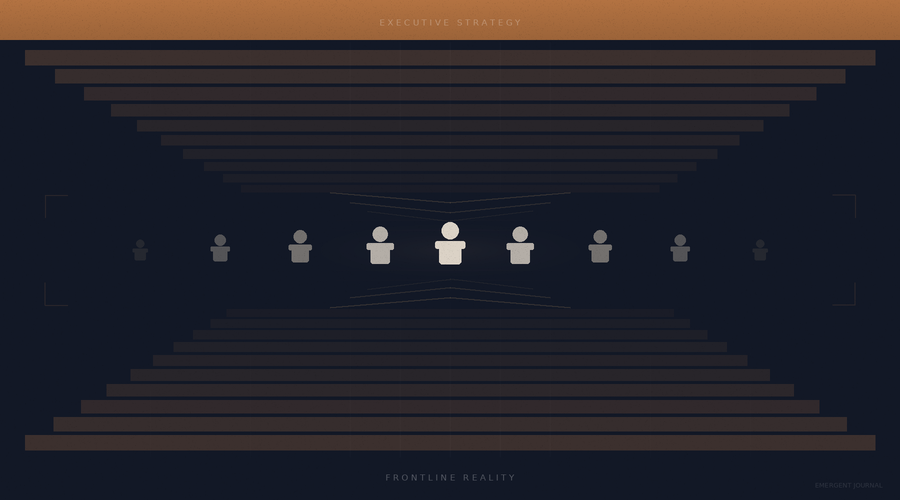
Every transformation has a blueprint. Executive sponsors set the vision. Change management teams build the communication plan. Frontline employees receive the training. But somewhere between the boardroom and the shop floor, there’s a layer of the organization that gets neither the strategic context nor the operational support it needs — and it happens to be the layer that determines whether the transformation lives or dies.
Middle managers are the translators of organizational change. They convert executive intent into team-level action, absorb employee anxiety, interpret ambiguous directives, and make hundreds of micro-decisions each week that collectively shape whether a transformation gains traction or quietly stalls. Yet in most transformation designs, they’re treated as message-carriers — conduits for slide decks they didn’t help create, delivering timelines they had no hand in shaping.
The result is predictable: the executives believe the transformation is on track because they’ve communicated the vision. The frontline believes it’s off track because nothing makes sense on the ground. And middle managers — the only people who can see both realities — are burning out trying to bridge the gap with no tools, no authority, and no air cover.
The Translation Layer Nobody Designed
Think of a large-scale transformation as a language problem. The C-suite speaks in strategy: market positioning, operating model shifts, three-year horizons. Frontline teams speak in operations: workflows, systems, daily metrics, customer interactions. These are fundamentally different languages, and middle managers are expected to be fluent in both — translating strategic ambition into operational reality in real time.
The problem is that most organizations never explicitly design for this translation. They invest heavily in executive alignment sessions and frontline training programs but skip the critical step of equipping the people in between. Middle managers are expected to absorb the strategy through a town hall, internalize it overnight, and show up the next morning ready to lead their teams through uncertainty. No tools. No coaching. No forum to pressure-test their understanding before they’re on stage.
When translation breaks down, the symptoms show up everywhere: inconsistent messaging across departments, teams working at cross-purposes, pockets of passive resistance that leadership can’t explain, and a growing sense among employees that “nobody really knows what’s going on.” These aren’t communication failures. They’re translation failures — and they originate in the middle.
The Squeeze From Both Directions
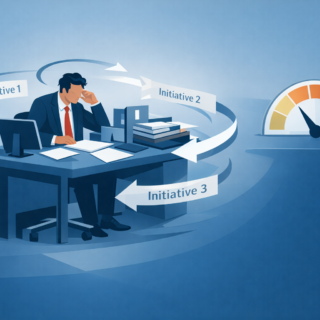
Middle managers during transformation face a unique form of organizational pressure. From above, they receive directives to accelerate adoption, hit milestones, and demonstrate enthusiasm for changes they may privately question. From below, they absorb the frustration, confusion, and fear of teams whose daily work is being disrupted. They’re expected to be both change champions and operational stabilizers — two roles that frequently conflict.
Research from McKinsey has found that middle managers spend roughly 35% of their time on administrative tasks during transformation, leaving precious little bandwidth for the leadership work that actually drives adoption. They’re drowning in reporting requirements, stakeholder updates, and coordination meetings while their teams need them to be present, visible, and coaching through uncertainty.
The squeeze intensifies when middle managers feel excluded from the decisions that shape the transformation. When they learn about pivots and timeline shifts at the same time as their teams — or worse, after — their credibility erodes. Employees are perceptive. They can tell when their manager is reading from a script versus speaking from conviction. And once that trust fractures, no amount of executive messaging can repair it.
What Effective Investment Looks Like
Solving the middle manager squeeze isn’t about adding another training module or distributing a FAQ document. It requires treating middle managers as a strategic asset in the transformation — investing in their capability, their context, and their authority.
Provide strategic context, not just talking points. Middle managers need to understand the “why behind the why.” They need to know which market pressures are driving the change, what alternatives were considered and rejected, where the leadership team is most uncertain, and what success looks like beyond the metrics. This level of context allows them to field the hard questions their teams will ask — and to make sound judgment calls when the playbook doesn’t cover the situation.
Create dedicated forums for sense-making. Before middle managers can lead their teams through change, they need space to process it themselves. Regular working sessions — not information cascades, but genuine two-way conversations — where middle managers can challenge assumptions, surface ground-level realities, and co-create implementation approaches. These forums serve a dual purpose: they improve the quality of execution plans and they build the commitment that comes from contribution.
Expand decision-making authority. One of the most corrosive dynamics in transformation is when middle managers are held accountable for outcomes but given no latitude to adapt the approach. If the rollout timeline doesn’t work for a particular team’s cycle, the middle manager should have authority to adjust it. If a communication approach isn’t landing, they should be empowered to redesign it for their audience. Distributed decision-making doesn’t weaken governance — it strengthens execution.
Build peer networks across the transformation. Middle managers in different functions face variations of the same challenges. A supply chain director navigating process redesign has more in common with a finance manager implementing a new planning system than either might expect. Structured peer cohorts — where middle managers share tactics, troubleshoot together, and build cross-functional relationships — create a resilience network that no top-down program can replicate.
The Early Warning System You’re Ignoring
Beyond their role as translators, middle managers are the organization’s most valuable source of transformation intelligence. They see the adoption gaps before they show up in dashboards. They hear the concerns that never surface in pulse surveys. They know which teams are genuinely adapting and which are performing compliance without commitment.
Yet most transformation governance structures don’t have a systematic way to capture this intelligence. Middle managers report upward through functional hierarchies, where their observations are filtered, summarized, and often sanitized before reaching the transformation leadership. By the time a problem is visible at the executive level, it’s typically been festering at the middle for weeks.
Organizations that create direct feedback channels from middle management to transformation leadership — skip-level forums, anonymous escalation paths, regular “ground truth” sessions — gain a significant advantage. They can course-correct faster, allocate resources to emerging bottlenecks, and demonstrate to the broader organization that leadership is listening, not just broadcasting.
Rewriting the Transformation Playbook
The conventional transformation playbook allocates the bulk of change management investment to two bookends: executive alignment and frontline adoption. The assumption is that if you get the top and bottom right, the middle will follow. That assumption is wrong — and it’s one of the primary reasons transformation failure rates remain stubbornly high.
Middle managers don’t need more communication. They need context, capability, authority, and connection. They need to be designed into the transformation as active architects of change, not passive relay stations. The organizations that figure this out gain something their competitors can’t easily replicate: a translation layer that turns strategic intent into operational reality at speed.
The next time your transformation team presents its change management plan, ask one question: What does this plan do for the people in the middle? If the answer is “cascade communications,” you have a translation problem waiting to happen. And in transformation, what gets lost in translation is usually the transformation itself.