


 Jesse Jacoby
The first time someone walks me through their stakeholder list on a major initiative, the document usually has one of two problems. Either everyone in the org has been listed (which is functionally the same as no one being prioritized), or the list reflects who the project sponsor happens to know personally (which is functionally the same as inheriting one person’s blind spots). Both versions produce the same outcome: the wrong people get the engagement attention, and the people who actually move the initiative get treated like a footnote.
Stakeholder prioritization is one of the fundamental building blocks of a change strategy. It is also one of the steps where teams most consistently get it wrong, often in ways that do not become visible until the initiative is well underway and momentum is already lost.
Two pitfalls account for most of the failures I see:
- Prioritizing on the wrong criteria. Teams over-index on org-chart seniority, geographic proximity, or who shows up most reliably in meetings, instead of who actually shapes whether the change lands.
- Prioritizing from too narrow a vantage. A list built by one or two people inevitably reflects their network. The stakeholders who fall outside that network end up under-weighted or invisible, and they are often the ones who decide outcomes.
What Counts as a Stakeholder
For a change initiative, a stakeholder is any individual or group that meets either of these tests:
- They will be impacted by changes resulting from the initiative, or
- They can influence the success of the initiative.
That second test is the one teams under-weight. Influence does not always live where the org chart says it does. A senior engineer with informal authority over their function’s adoption choices may have more influence than the VP who technically owns the area. A respected mid-level manager who carries credibility with the front line is often a more consequential stakeholder than the executive who signed the program charter.
The Two-by-Two
Mapping stakeholders against impact and influence gives you a simple, durable framework for deciding where to spend the limited engagement bandwidth a change leader has.
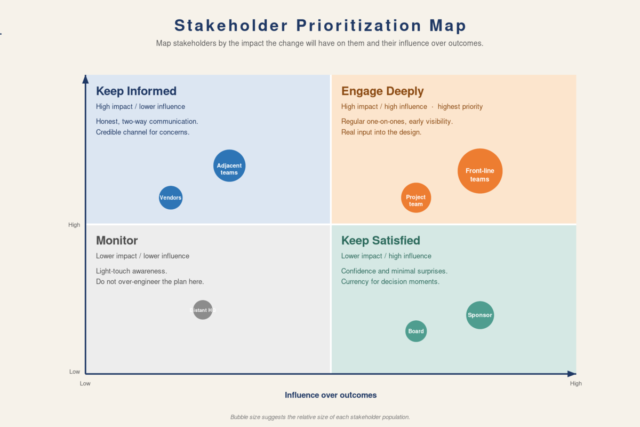
The four quadrants behave differently, and they call for different engagement strategies.
Engage Deeply (high impact, high influence). These are the stakeholders who both feel the change and shape whether it lands. They get the most of your attention: regular one-on-ones, early visibility into decisions, real input into the design. Get this quadrant wrong and the initiative does not recover.
Keep Informed (high impact, lower influence). These are the people the change will affect most, even if they cannot shape it from the top. They need honest, regular, two-way communication and a credible channel to surface concerns. Underinvest here and you create the conditions for quiet resistance and adoption drag.
Keep Satisfied (lower impact, high influence). These are the executives, partners, and external stakeholders whose buy-in protects the initiative even though they are not directly absorbing the change. They need confidence in the work and minimal surprises. Their satisfaction is currency you spend at decision moments.
Monitor (lower impact, lower influence). Light-touch awareness is enough here. Do not over-engineer the engagement plan for this quadrant. The cost of doing so is borne by the other three.
Why the Map Looks Different Now
A few things have shifted since I first wrote about stakeholder prioritization, and they all push toward making the analysis more rigorous, not less.
The map has more stakeholders on it. Modern enterprises run with more partners, contractors, vendors, and adjacent teams than they used to. The stakeholder universe for a typical transformation is genuinely larger than it was a decade ago, and the boundaries between internal and external have softened.
Influence is more distributed. Org-chart authority no longer maps cleanly to organizational influence. The people who shape a change initiative may sit several layers below the executive sponsor, run a community of practice, or simply be the person their peers consult before forming an opinion.
The middle of the org carries more weight than ever. As I wrote in The Middle Manager Squeeze, the middle layer is now the leverage point on whether change actually moves. Initiatives that prioritize middle managers as a stakeholder group land more reliably than those that treat them as a communication channel.
AI shifts the impact axis. Initiatives that touch AI or automation move stakeholders up the impact axis in ways the old framing did not anticipate. A team that feels their work is about to be reshaped by AI is, in stakeholder terms, high-impact whether or not anyone has acknowledged it. Getting this read wrong creates the conditions for resistance that looks irrational from above and is anything but from below.
How to Actually Build the Map
The mechanics are simple. The hard part is making the analysis honest.
Get input from people who see the org differently than you do. The map should not be drawn by one or two people in a conference room. Bring in the executive sponsor, the project team, leaders from the affected business units, HR partners, communications, and anyone else who can pressure-test the assumptions. Diversity of perspective is what saves you from inheriting a single person’s blind spots.
Calibrate against reality. Once you have a draft, walk three real, recent decisions through it. Did the right stakeholders show up on the right ones? If not, your map is mis-calibrated, and now is the time to find that out rather than at the first resistance event.
Watch for the missing quadrant. Most stakeholder maps I see are crowded in two quadrants and nearly empty in a third. Empty quadrants are usually a sign of an analytic blind spot, not of an organization where those stakeholders genuinely do not exist.
Plan the engagement at the same time you draw the map. A prioritization map without a corresponding engagement plan is an academic exercise. Each quadrant should have a named owner, a cadence, and a set of artifacts that flow to that audience.
Re-draw it. The stakeholder map is not a one-time document. Reorganizations, leadership changes, scope changes, and shifting external context all change who matters. Build a habit of revisiting it at least quarterly on a long-running initiative.
The Cost of Getting This Wrong
Most failed transformations did not fail because the strategy was wrong. They failed because the engagement plan was built around the wrong people. Stakeholder prioritization is one of the highest-leverage activities a change leader does, and one of the most consistently rushed. The hour you invest in getting this right at the front end usually saves you weeks of recovery work later.







2 comments
Pingback: How to Select Stakeholder Engagement Strategies «
Mike Clayton
at 11:53 am
Hi Jesse. Thank you for your kind comment on my blog.
Your readers may like to consider a variation to this tool that they can also use – similar, but rather than consider the impact on the stakeholders; this one divides stakeholders into those with a generally positive attitude to the change (supporters) and those who oppose it (detractors).
When these divisions are useful, I find that this leads to more clear-cut strategies. You and your readers can see this alternative approach in “Avoid Resistance”, here.
Mike Clayton
Author of the Handling Resistance Pocketbook
Buy it from Amazon.com